
Taking both direct and indirect taxes, the gross collection is expected to grow 10.45 per cent to Rs 33.61 trillion in 2023-2024.

Though COVID-19 and the subsequent lockdown left a trail of economic devastation on most countries, India can potentially build upon three positive aspects - push in the rural economy, stronger federalism and a huge consumption base, former RBI Governor Duvvuri Subbarao Rao has said. In his foreword on a Telugu book titled "Maandhyam Mungita Desam" (Nation in Recession) authored by Tummala Kishore, he said the challenge for the government in the months and years ahead is clear: to put the economy back on a healthy growth trajectory and ensure that growth is inclusive, with lower income households too enjoying the benefits of rapid growth.

The Centre is unlikely to offer new direct tax incentives for units operating in special economic zones (SEZs) and may instead allow the grandfathering of previous exemptions that such units were entitled to, according to proposed amendments to the SEZ Act, 2005, people aware of the matter said. The amendments, proposed by the commerce department, will soon be considered by the Cabinet for approval. This represents a departure from the department's earlier plan to introduce these changes through the Development Enterprises and Services Hubs (DESH) Bill, 2023, which faced strong criticism from the ministry of finance.

Economist Deepak Nayyar says economic openness, while necessary, is not sufficient, and is conducive to development only when combined with industrial policy.

Finance Minister Arun Jaitley announced slew of reforms for the masses.

Muslims' share in the reservation will keep on increasing also because of "conversion and infiltration because they are having a secular cover from them (the Congress)", he added.

The recovery in the Indian services sector was sustained in November as new work orders supported business activity growth and the first rise in employment in nine months, a monthly survey said on Thursday.

'What's sad today is that there are so many people who cannot find work, not because the country is devoid of that opportunity, but because we are not doing enough in the country.'

Hockley, when asked about the report, denied suggestions that the powerful nations were turning a blind eye to Test cricket, saying he had met Snedden during the New Zealand-Australia first Test in Wellington and conveyed to him that Australia was very much committed to help ICC ensure all the three formats flourish.

Amid the rhythmic chug of the train, a chorus of voices rises, each bearing its tale of hope and despair.

The industry is expecting double-digit growth on a year-on-year basis, helped by a possible price correction after softening of raw material inputs and factors such as positive sentiments, pent up demand and improving economic conditions. Besides, a shift in consumer behaviour from price consciousness towards technologically advanced premium products with quality, value proposition and safety aspects leading to a rise in demand for home automation products is making the industry upbeat. With the government's production linked incentive (PLI) scheme for white goods, which has witnessed a committed investment of Rs 4,614 crore, in place, many manufacturers are gearing up to make the most out of the opportunity as well as take steps towards reducing their dependency on imports and make products more affordable.

Modi said today "we all have reached an important and historic partnership".

'It feels like Assam is good just as a tourist spot and not a place to earn and live.'
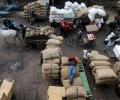
India has already become the world's fifth largest economy in the 75th year of Independence and will reach the $3.5 trillion mark by end-March, said the Economic Survey tabled in Parliament on Tuesday. In real terms, the economy is expected to grow at 7 per cent for the year ending March 2023. This follows an 8.7 per cent growth in the previous financial year.


Bangladesh is in turmoil, which is not good news for India, which shares a porous 4000 km border with it. There is a danger of fundamentalism growing there, and India has to move in to reset its ties with the new dispensation before China and Pakistan make capital out of it, alerts Ramesh Menon.

Finance Minister Nirmala Sitharaman on Thursday said Pradhanmantri Suryodaya Yojana will enable one crore families to get up to 300 units of free electricity monthly and help them save up to Rs 18,000 annually. "There is provision of Rs 10,000 crore for rooftop solar (scheme) in the Budget," said finance secretary T V Somanathan in press conference on Budget later in the day. Earlier in the day Sitharaman in her interim Budget speech said through rooftop solarisation, one crore households will be enabled to obtain up to 300 units of free electricity each month.

RBI said at the current juncture, the all-out effort is to maintain and sustain, with the hope that when life is secure, resources, energy and time can be marshalled to rebuild and revive.

'This debate is going on all over the world and everybody is saying that only GDP cannot estimate the real (economic) situation of a country.'
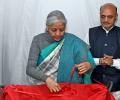
The interim Budget proposals that will be presented on February 1 in the backdrop of the general elections scheduled in April/May 2024 are likely to have a hint of populism, believe analysts, but are unlikely to derail the government from its path of fiscal prudence.

The new data comes a day after China and the US signed a long-awaited phase one deal, marking a ceasefire in the 18-month-long trade war which saw the world's two largest economies slap 25 per cent tariffs on about half a trillion-dollar worth of each other's exports. The world's second-largest economy grew by 6.1 per cent last year, its worst performance since 1990, but it remained above the psychologically important mark of six per cent, according to the National Bureau of Statistics (NBS).

Manufacturing activities in India gained momentum in August as new orders and output increased at the quickest rates in nearly three years, according to a survey released on Friday. The seasonally adjusted S&P Global India Manufacturing Purchasing Managers' Index (PMI) rose to 58.6 in August from 57.7 in July. Pollyanna De Lima, Economics Associate Director at S&P Global Market Intelligence, said the PMI results for India painted a vibrant picture of the nation's manufacturing landscape in August.

In August, the top BRICS leaders at the grouping's summit in Johannesburg approved a proposal to admit six countries, including Argentina, into the bloc with effect from January 1.

Kamal Haasan is right where he left off from the first film but there is only so much he can do to salvage an already lost cause, observes Arjun Menon.

Both BJP and Congress are offering more of the same, without appearing to realise that welfarism can cause bigger economic problems if adequate growth is not ensured.

If Saudi Arabia, with just two Muslim holy sites of Mecca and Medina, can create a huge tourism-based ecosystem beyond oil, Ayodhya is sure to become the world's hottest religious tourism site in less than a decade, predicts R Jagannathan.

The National Human Rights Commission, in its report, also observed that the "pervasive fear of reprisal, coupled with the power dynamics at play, acted as a formidable barrier", preventing individuals from voicing their grievances.

S&P Global Ratings on Monday retained India's GDP growth forecast at 6 per cent saying it will be the fastest growing economy among Asia Pacific nations. The GDP growth forecast for the current and the next fiscal has been kept unchanged from the forecast made in March partly on account of domestic resilience. "We see the fastest growth at about 6 per cent in India, Vietnam, and the Philippines, S&P Global Ratings said in its quarterly economic update for Asia-Pacific.

'The question is, how soon we can expect to re-attain the pre-lockdown levels of output and income.'

Among the Sensex firms, JSW Steel, Tata Steel, Tech Mahindra, Infosys, Wipro, Tata Consultancy Services, Nestle, HCL Technologies, HDFC Bank and Maruti were the major laggards. IndusInd Bank, ITC, Bharti Airtel and State Bank of India were among the winners.
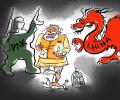
'Modi has presided over an ultra-nationalism that has stunted India's growth, been unable to change the country's external situation, brought foreign intervention into Indian affairs,' explains Aakar Patel.

'...which is possible through flexicap and multicap funds.' 'The latter has a better balance between large, mid and smallcap stocks.'
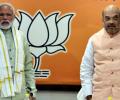
Corporate leaders said a stable government at the Centre will help boost infrastructure spend, address agricultural distress, and encouraging employment.
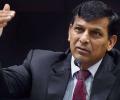
Indian economy, dubbed the fastest growing major economy in the world, is faced with the single most important pressure point of job creation, says former RBI Governor Raghuram G Ranjan as he makes a strong case for improvement of human capital through skill development. Talking about the book 'Breaking the mould: Reimagining India's economic future', written jointly by him and Rohit Lamba, assistant professor of economics at Pennsylvania State University, Rajan said one of the greatest strength of India is its human capital of 1.4 billion and the question is "how do you make it strong?" The nation needs to create jobs at every level going along the path of development, said Rajan, presently Katherine Dusak Miller Distinguished Service Professor of Finance at Chicago Booth, USA.

To do so, the government will have to tackle a number of broad development challenges successfully, says Shankar Acharya
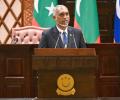
Maldivian President Mohamed Muizzu's party secured a 'supermajority' in Parliament by winning over 60 seats in Sunday's crucial parliamentary election, seen as a litmus test for the pro-Beijing politician whose policies are being closely watched by both India and China amidst regional power dynamics.

The NCEAR has indicated some improvement in the fourth quarter of the current financial year.
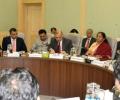
At a pre-Budget meeting, the FM was asked to ensure that NBFCs come out of the liquidity crisis they are facing with the help of RBI. They also spoke about the futility of trying to achieve a 3 per cent fiscal deficit target over the medium term.

The government will formulate a strategy to make India self-reliant in edible oils by boosting domestic output of oilseeds and launch a comprehensive programme to support dairy farmers, Finance Minister Nirmala Sitharaman announced on Thursday. India imports a large quantity of edible oils to meet the domestic demand. During the 2022-23 marketing year (November-October), the country imported nearly 165 lakh tonnes of cooking oils, valuing a whopping Rs 1.38 lakh crore.

'Rhetoric and chest-thumping are running high on India's recent growth record.'
'But will the giant waves developing elsewhere allow us to sail smoothly into fair winds?' asks Debashis Basu.
 © 2026 Rediff.com - Advertise with us - Disclaimer - Privacy Policy - Sitemap - Feedback - About us - Terms of use - Grievances